The PPWR in plain language: what the EU packaging rules mean for companies selling products in the EU
Last updated: 5 November 2026 · By Bruno Duarte, founder of VERAEN, 15+ years in product compliance
If you sell a product in a box, a bag or a carton anywhere in the EU, the new EU packaging rules apply to you. Since 12 August 2026, the Packaging and Packaging Waste Regulation (PPWR) sets the same rules in every EU country. This guide explains, in plain language, who is responsible, what applies now, what comes next, and what to do.
On this page
In short
- The PPWR, Regulation (EU) 2025/40, has applied in every EU country since 12 August 2026. It replaced the old Packaging Directive.
- It covers all packaging: the box your product is sold in, the outer carton, the polybag, the shipping box for online orders.
- The "manufacturer" of packaging is usually the brand whose name is on it, not the company that made the box. That company carries most of the duties.
- Since August 2026, each type of packaging needs technical documentation and an EU declaration of conformity, and must stay below a limit for heavy metals.
- Bigger changes follow from 2028 to 2030: harmonised sorting labels, recyclability rules, recycled content in plastic, less empty space, and reuse targets.
What the PPWR is
The Packaging and Packaging Waste Regulation, Regulation (EU) 2025/40, sets EU-wide rules for all packaging placed on the EU market. It entered into force on 11 February 2025 and has applied since 12 August 2026.
It replaces the old Packaging Directive (94/62/EC). The old rules were a directive, so each country wrote its own version. The PPWR is a regulation: the same text applies directly in all 27 EU countries.
Its aim is less packaging waste and more recycling. To get there, it sets rules on:
- what packaging may contain (heavy metals, and PFAS in food packaging);
- how packaging is designed (recyclable, minimal, with less empty space);
- how much recycled plastic it contains;
- how it is labelled, and how compliance is documented;
- who pays for collection and recycling (extended producer responsibility, or EPR).
The rules apply to packaging made in the EU as well as imported packaging, and to packaging sold empty as well as packaging that holds a product. Packaging already placed on the market before 12 August 2026 does not have to be withdrawn.
Who is responsible: the "manufacturer" is usually the brand
Under the PPWR, the manufacturer of packaging is the company that makes it, or has it designed or made under its own name or trademark. In practice, the brand whose name is on the packaging is the manufacturer, even if a supplier produced the box. For sales packaging, this is usually the company that fills it with the product. There is only one manufacturer for each packaging unit.
Example: a clothing brand orders printed polybags and cartons from a packaging supplier and has its garment factory pack the clothes. The brand is the manufacturer of that packaging, not the supplier or the factory.
Manufacturer
- Who it is:
- The brand that has packaging made or filled under its own name, or makes it itself
- Main duties:
- Make sure packaging meets the rules, draw up technical documentation and an EU declaration of conformity, put its name and address on the packaging, keep the documents for 5 years (10 for reusable packaging)
Supplier
- Who it is:
- A company that supplies packaging or parts of it to the manufacturer
- Main duties:
- Give the manufacturer the information and documents it needs to show compliance
Importer
- Who it is:
- A company in the EU that places packaging or packaged products from outside the EU on the market
- Main duties:
- Check that the manufacturer did its part, that the documents exist and that the packaging is labelled; add its own name and address
Distributor
- Who it is:
- A company that sells packaged products already on the market, such as a wholesaler or retailer
- Main duties:
- Check that the manufacturer and importer met their duties, and act if something is wrong
Fulfilment service provider
- Who it is:
- A warehouse or logistics company that stores, packs and ships for online sellers
- Main duties:
- Make sure its handling does not break compliance; only work for sellers who met their duties
Producer (for EPR)
- Who it is:
- The company that first makes packaging available in a given EU country
- Main duties:
- Register in that country's packaging register, report packaging volumes and pay recycling fees, usually through a producer responsibility organisation
Two points often missed:
- A company can have several roles at once. An importer that puts its own brand on the packaging is also the manufacturer.
- EPR applies country by country. If you sell directly to end users in an EU country where you are not established, you need an authorised representative for EPR in that country.
There is one exception for micro-enterprises (fewer than 10 employees and turnover or balance sheet of up to €2 million): if a micro-enterprise has packaging made under its own name by a supplier located in the same EU country, that supplier is the manufacturer.
What applies now and what comes later
The PPWR applies in stages. The paperwork, the substance limits and a basic recyclability duty already apply; most design changes start in 2030.
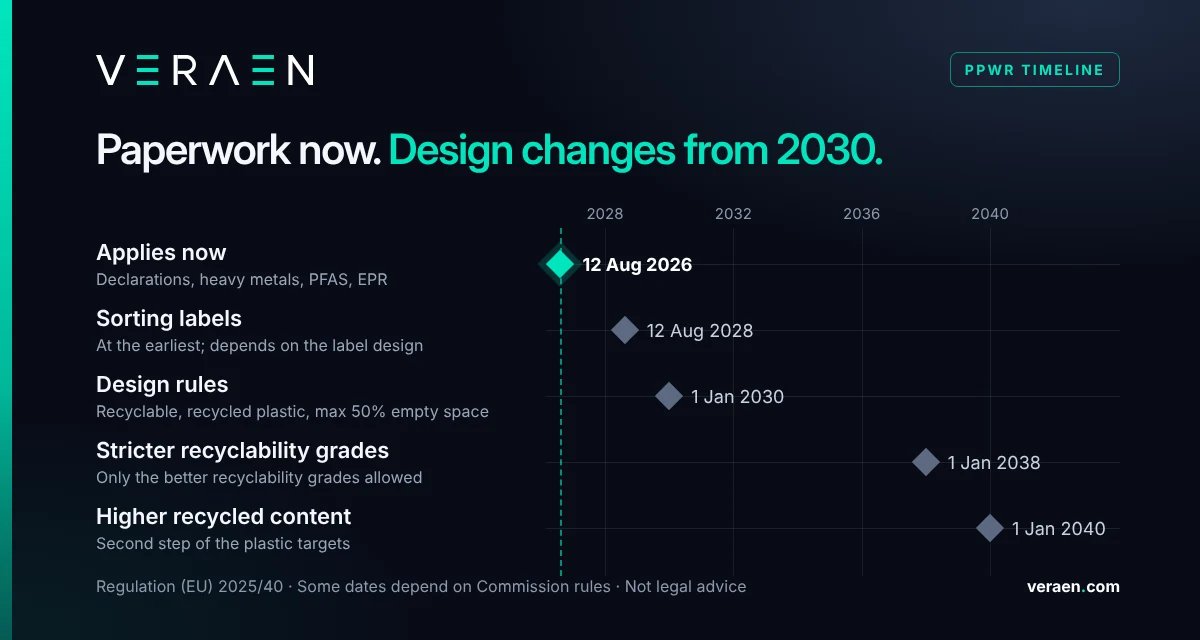
Already applies (since 12 August 2026)
- Technical documentation and EU declaration of conformity for each type of packaging, drawn up by the manufacturer.
- Heavy metals: lead, cadmium, mercury and hexavalent chromium together must stay at or below 100 mg/kg in all packaging. This limit existed before, but must now be documented.
- Substances of concern: a general duty to keep them to a minimum.
- PFAS in food-contact packaging: strict limits on these "forever chemicals" in packaging that touches food.
- Identification: a type, batch or serial number, and the manufacturer's name and postal address, on the packaging or in a QR code. An accompanying document is only allowed where that is not possible. Importers add their own name and address too.
- Producer registration (EPR): registration in the packaging register of each EU country where you first make packaging available.
- Recyclability: packaging must be recyclable. Until the detailed EU design-for-recycling criteria apply, the recyclability requirements carried over from the old Packaging Directive apply.
Coming next
- From 12 August 2028 at the earliest: harmonised labels showing what the packaging is made of, to help consumers sort waste. The exact date depends on when the Commission adopts the label design.
- From 1 January 2030:
- All packaging must meet EU design-for-recycling criteria and reach recyclability grade A, B or C (from 1 January 2030, or 24 months after the Commission adopts the criteria, whichever is later).
- Plastic packaging must contain a minimum share of recycled plastic (from 1 January 2030, or three years after the Commission's calculation rules, whichever is later), for example 35% for most plastic packaging that is not contact-sensitive, meaning not used for food, cosmetics or medicines.
- Packaging must be reduced to the minimum weight and volume needed. Double walls, false bottoms and unnecessary layers that only make a product look bigger are not allowed. Some experts read this ban as already applying, so avoid such features in new designs now.
- The company that fills grouped, transport or e-commerce packaging must keep empty space to at most 50%, counting fillers such as paper or air cushions as empty. Shipping a product in its own retail box is exempt.
- Reuse targets start for transport packaging, and some single-use plastic formats are banned.
- 2038 and 2040: from 2038 only recyclability grades A and B are allowed; from 2040 the recycled-content targets rise.
Several of these dates depend on detailed rules the Commission still has to adopt, so some may move later. We will update this guide when they are published.
What it means for your sector
Every sector has packaging under the PPWR. What changes is where the effort goes.
Apparel and textiles
- Typical packaging:
- Polybags, shipping cartons, tissue paper, dust bags for shoes and garments, hangers sold with clothing, hang tags attached to the product
- What to watch:
- Plastic polybags need recycled content from 2030; dust bags count as packaging; e-commerce boxes face the 50% empty-space limit
Furniture
- Typical packaging:
- Large cartons, foam and corner protectors, plastic film, wooden pallets
- What to watch:
- Bulky protective packaging must be minimised; foam and mixed materials need a recyclable design; pallets count as transport packaging
Toys
- Typical packaging:
- Display boxes with windows, blister packs, plastic ties and trays
- What to watch:
- Mixed paper and plastic is harder to recycle; plastic trays and blisters need recycled content from 2030
Home goods
- Typical packaging:
- Retail boxes, paper or plastic inserts, shrink film, e-commerce mailers
- What to watch:
- Oversized boxes and false bottoms are not allowed from 2030; heavy metals in printed or coloured packaging must stay within limits now
For all sectors, the first step is the same: list every type of packaging you use, and who supplies it.
The data you need from packaging suppliers
As the manufacturer, you sign the declaration of conformity, but most of the evidence comes from your packaging suppliers and their material suppliers. Since August 2026, suppliers must give you the information you need.
Description of each packaging type and its parts
- Why you need it:
- Technical documentation
- Who usually holds it:
- You and your packaging supplier
Material of each part (paper, PE, PP, PET, wood…)
- Why you need it:
- Technical documentation, sorting labels, EPR reporting
- Who usually holds it:
- Packaging supplier
Weight of each part
- Why you need it:
- EPR fees per material, minimisation
- Who usually holds it:
- Packaging supplier
Heavy metals test results or supplier declaration
- Why you need it:
- 100 mg/kg limit
- Who usually holds it:
- Packaging supplier, ink or pigment supplier
PFAS test results (food-contact packaging only)
- Why you need it:
- PFAS limits
- Who usually holds it:
- Packaging or paper supplier
Recycled content, with proof
- Why you need it:
- Recycled-content targets from 2030
- Who usually holds it:
- Plastic or paper supplier
Recyclability assessment
- Why you need it:
- Design-for-recycling rules from 2030
- Who usually holds it:
- Packaging supplier, checked by you
Quantities placed on the market, per EU country
- Why you need it:
- EPR registration and reporting
- Who usually holds it:
- You
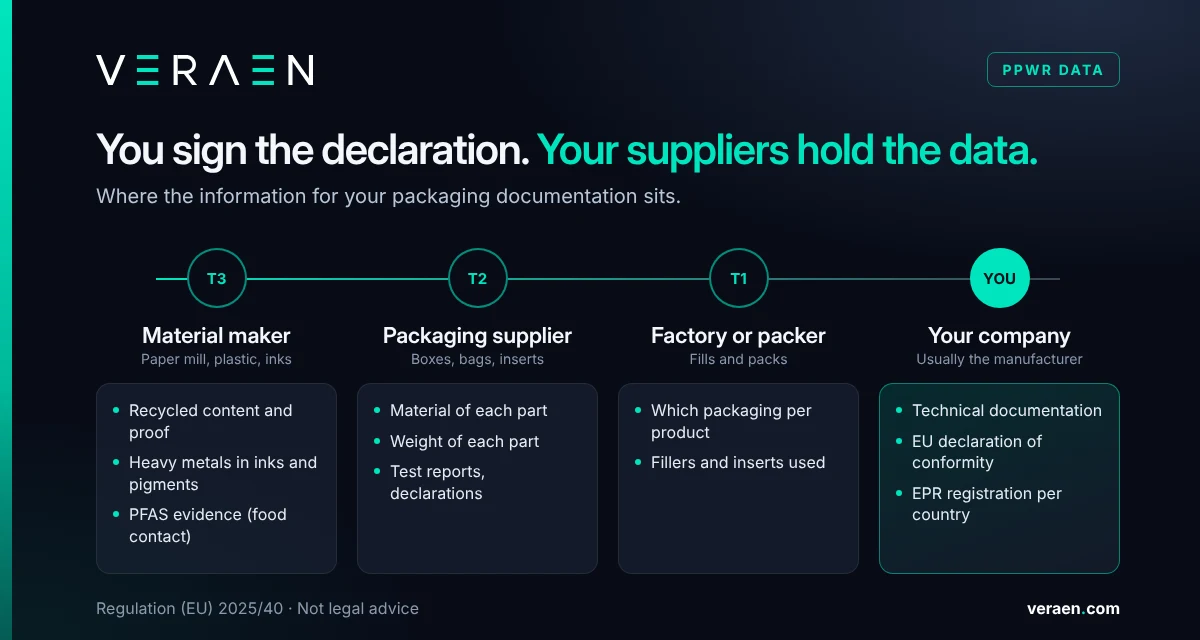
The hardest part is usually the first step: getting a complete list of packaging parts, with materials and weights, for every product. Once that list exists, most other requirements build on it.
Checklist
The rules already apply, so start with what is required today, then prepare for 2030.
Now
- List every type of packaging you use, per product: sales packaging, outer cartons, shipping boxes, fillers, labels.
- Decide your role for each packaging type and each EU country: manufacturer, importer, distributor, and producer for EPR.
- Ask your packaging suppliers for materials, weights, and heavy metals declarations or test reports. For food-contact packaging, ask for PFAS evidence too.
- Draw up the technical documentation and the EU declaration of conformity for each packaging type where you are the manufacturer.
- Check the packaging carries your name and postal address.
- Register as a producer in each EU country where you first make packaging available, usually through a producer responsibility organisation. If you sell directly to end users in an EU country where you are not established, appoint an authorised representative for EPR there.
- Keep the documents for 5 years (10 for reusable packaging).
Before 2030
- Review your designs for recyclability, and replace mixed materials that are hard to recycle.
- Plan recycled plastic in your plastic packaging, and agree proof of recycled content with suppliers.
- Measure the empty space in grouped, transport and e-commerce packaging, and resize boxes where needed.
- Prepare for the new sorting labels once the Commission publishes the design.
Frequently asked questions
When does the PPWR apply?
Since 12 August 2026, in every EU country. Many design requirements, such as recyclability, recycled content and empty space limits, start on 1 January 2030.
I buy my boxes from a supplier. Am I still the manufacturer?
Usually yes. If the packaging carries your name or brand, or you fill it with your product, you are normally the manufacturer, even if someone else made it.
Do I need a declaration of conformity for packaging?
Yes. Since 12 August 2026, the manufacturer must draw up technical documentation and an EU declaration of conformity for each type of packaging.
Does the PPWR apply to small companies?
Yes. There is no general exemption for small companies. One exception: if a micro-enterprise has packaging made under its name by a supplier in the same EU country, the supplier is the manufacturer and takes on most duties.
Do I have to change my packaging labels now?
Not yet. The harmonised sorting labels apply from 12 August 2028 at the earliest. Your name and address must already be on the packaging.
What about packaging I already had in stock?
Packaging placed on the market before 12 August 2026 can still be sold. It does not have to be withdrawn.
Is the PPWR the same as packaging EPR?
No, but the PPWR now sets the EU-wide frame for EPR. You still register and pay fees in each EU country where you first make packaging available.
Is cardboard packaging for my products also covered by the EUDR?
Not when it only protects or carries your product and is sold with it: that packaging has been outside the EUDR since 18 September 2026. It is still covered by the PPWR. See our EUDR guide.
How VERAEN is designed to help
VERAEN is a product compliance platform with expert support, currently in pre-launch. It is designed to:
- Collect packaging data once from your suppliers: parts, materials, weights, declarations and test reports.
- Check each product against the rules that apply to it, and reuse the same supplier data for the PPWR, GPSR, EUDR and the Digital Product Passport.
- Give you ongoing support from a compliance specialist, to know which rules apply to your company and when.
Want to know when EU product rules change, and when VERAEN launches? Sign up for our compliance updates.
Follow VERAEN on LinkedIn
A short update on EU product rules, every week.
Have a question about your packaging?
Not sure whether you are the manufacturer, or what applies to your packaging? Send us a message or book a short call, and a product compliance specialist will get back to you.
This guide is general information, not legal advice. It reflects the rules as of 5 November 2026. Check the official sources below for your own situation.