The EUDR in plain language: what companies selling in the EU need to do before 30 December 2026
Last updated: 5 November 2026 · By Bruno Duarte, founder of VERAEN, 15+ years in product compliance
From 30 December 2026, wooden furniture, paper, rubber, coffee, cocoa and other everyday products can only be sold in the EU with proof that they are not linked to deforestation. This guide explains, in plain language, which products are covered, who has to do what, which data you need, and what to do in the weeks left.
On this page
In short
- From 30 December 2026, listed products made from cattle, cocoa, coffee, oil palm, rubber, soya or wood can only be sold in the EU if they are deforestation-free, legally produced and covered by a due diligence statement.
- Only the products on the EU's list are covered. A product made of wood is not automatically in scope: its customs code decides.
- Most micro and small companies get until 30 June 2027, but not for timber products that were already covered by the old EU Timber Regulation, such as most wooden furniture.
- The company that first places the product on the EU market does the due diligence. Companies further down the chain mainly collect and keep reference numbers.
- The hardest part is the data: the exact location of the plot of land where the raw material was produced, which often sits three or four steps back in your supply chain.
What the EUDR is
The EU Deforestation Regulation, Regulation (EU) 2023/1115, stops products linked to deforestation from being sold in or exported from the EU. It replaces the old EU Timber Regulation and covers seven raw materials: cattle, cocoa, coffee, oil palm, rubber, soya and wood.
A covered product may only be placed on the EU market if it meets three conditions:
- Deforestation-free. The raw material was not produced on land that was deforested or degraded after 31 December 2020, the cut-off date.
- Legal. It was produced in line with the laws of the country of production, for example on land use, environmental protection, labour and tax.
- Covered by a due diligence statement. The company that first places it on the market has checked the first two points and filed a statement in the EU information system.
The rule applies to products made in the EU as well as imported ones. A chair made in Portugal from Portuguese wood is covered just like a chair imported from Vietnam.
Which products are covered
A product is covered only if its customs code (CN code) is listed in Annex I of the EUDR. Being made of wood, rubber or soya is not enough on its own. The list was updated on 18 September 2026 by Delegated Regulation (EU) 2026/2102, so older product lists may be out of date.
Furniture and home
- Usually covered:
- Wooden furniture (CN 9403 30, 40, 50, 60 and 91), wooden seats and seat parts, wooden frames and kitchenware, plywood, particleboard and fibreboard
- Usually not covered:
- Furniture of metal or plastic, used and second-hand furniture
Packaging and paper
- Usually covered:
- Paper, paperboard, cartons and wooden pallets sold as products in their own right
- Usually not covered:
- Packaging used only to support, protect or carry another product and sold with it; printed products such as books
Apparel and textiles
- Usually covered:
- Clothing accessories and gloves of natural rubber (ex 4015)
- Usually not covered:
- Cotton and other textiles; cattle hides and leather (removed on 18 September 2026)
Toys
- Usually covered:
- –
- Usually not covered:
- Toys, even with wooden parts, because toys are not on the list
Food and personal care
- Usually covered:
- Cocoa, chocolate, coffee, soya, palm oil and listed palm oil derivatives
- Usually not covered:
- Products not on the list
Some products were added in September 2026, such as soluble coffee and certain palm oil derivatives. They are covered from 30 December 2027, one year later than the rest.
Also outside the scope: waste, products made entirely from recycled material, and used or second-hand goods. Always check your exact CN code against the current Annex I before deciding.
Deadlines
The EUDR applies from 30 December 2026 for large and medium companies. Regulation (EU) 2025/2650 moved the dates for the second time in December 2025.
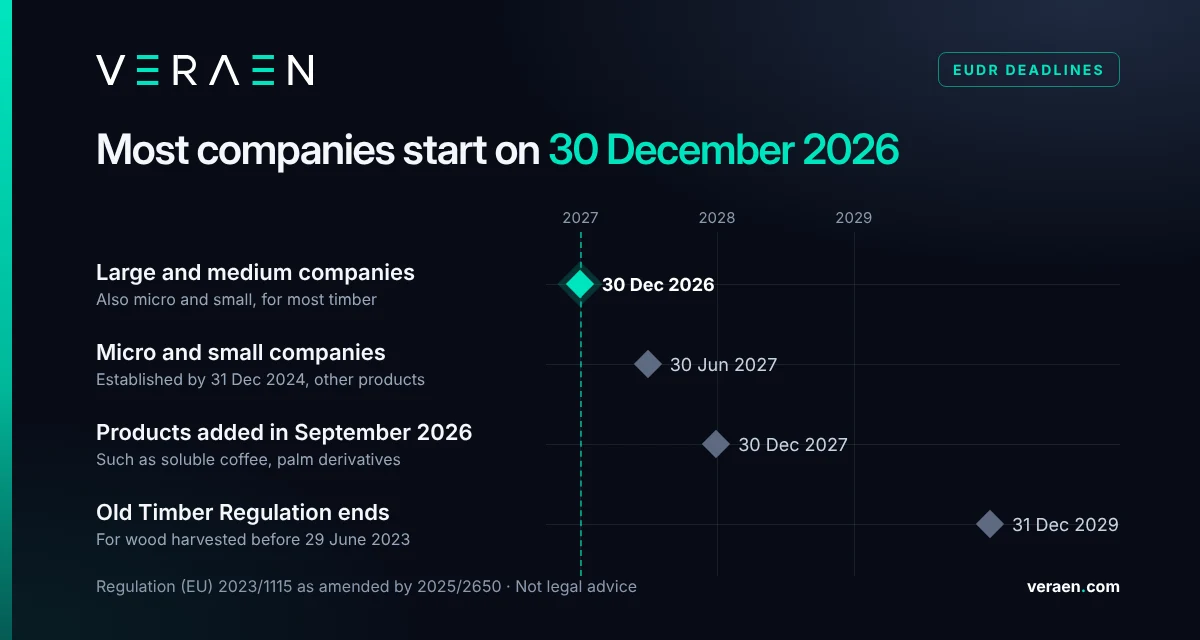
- 30 December 2026: large and medium companies. Also micro and small companies placing timber products that were already covered by the old EU Timber Regulation, such as most wooden furniture, plywood and paper.
- 30 June 2027: natural persons and micro or small companies that were established as such by 31 December 2024, for all other products.
- 30 December 2027: products added to the list in September 2026, such as soluble coffee and certain palm oil derivatives.
- Until 31 December 2029: timber products made from wood harvested before 29 June 2023 stay under the old EU Timber Regulation rules. After that date, the EUDR applies whatever the harvest date.
Micro and small follow the EU accounting rules (Directive 2013/34/EU, as updated in 2023). A small company does not exceed two of three limits: 50 employees, €10 million turnover and €5 million balance sheet total. For a micro company the limits are 10 employees, €900,000 turnover and €450,000 balance sheet total.
Your role decides what you must do
Only the company that first places a covered product on the EU market does full due diligence and files the due diligence statement. Since Regulation (EU) 2025/2650, companies further down the chain no longer file their own statements.
Operator
- Who it is:
- The first company to place the product on the EU market or export it: an importer, or an EU company that harvests or produces the raw material itself
- What you must do:
- Collect the information, assess and reduce the risk, file a due diligence statement for each product before placing it on the market, keep records for 5 years
Downstream operator
- Who it is:
- An EU company that makes or exports products from materials already covered by a due diligence statement, such as a furniture maker buying EU plywood
- What you must do:
- No statement of your own. If your supplier is the operator, collect and keep its statement reference number. Companies that are not SMEs must register in the EU information system
Trader
- Who it is:
- A company that sells products already on the EU market without changing them, such as a distributor or retailer
- What you must do:
- No statement. Keep the details of your suppliers and customers. Traders that are not SMEs must register in the EU information system
Only the first company after the operator has to keep the reference number; it does not have to pass it further down the chain. Downstream operators and traders must still act if they receive substantiated concerns that a product does not comply.
Micro and small companies that produce the raw material themselves in a low-risk country, such as a small forest owner, are "micro or small primary operators". They submit a one-off simplified declaration instead of a statement for each shipment.
The data you need
Article 9 of the EUDR lists the information an operator must collect for each product. Most of it does not sit with your direct supplier but further back, where the raw material was grown or harvested.
Product description and trade name
- Example (wooden chair):
- Oak dining chair, model "Lisa"
- Who usually holds it:
- You or your direct supplier
Tree species, for wood: common and scientific name
- Example (wooden chair):
- Oak, Quercus robur
- Who usually holds it:
- Sawmill or timber supplier
Quantity
- Example (wooden chair):
- 1,200 kg, or 400 units
- Who usually holds it:
- You or your direct supplier
Country of production
- Example (wooden chair):
- Croatia
- Who usually holds it:
- Sawmill or forest owner
Geolocation of every plot of land
- Example (wooden chair):
- GPS points or plot outlines
- Who usually holds it:
- Forest owner or harvester
Date or period of production
- Example (wooden chair):
- Harvested March to May 2025
- Who usually holds it:
- Forest owner or harvester
Supplier and customer details
- Example (wooden chair):
- Names, postal and email addresses
- Who usually holds it:
- You
Proof the land was not deforested after 31 December 2020
- Example (wooden chair):
- Satellite checks, forest records
- Who usually holds it:
- Forest owner, or checked by you
Proof of legal production
- Example (wooden chair):
- Harvest permits, concession documents
- Who usually holds it:
- Forest owner or harvester
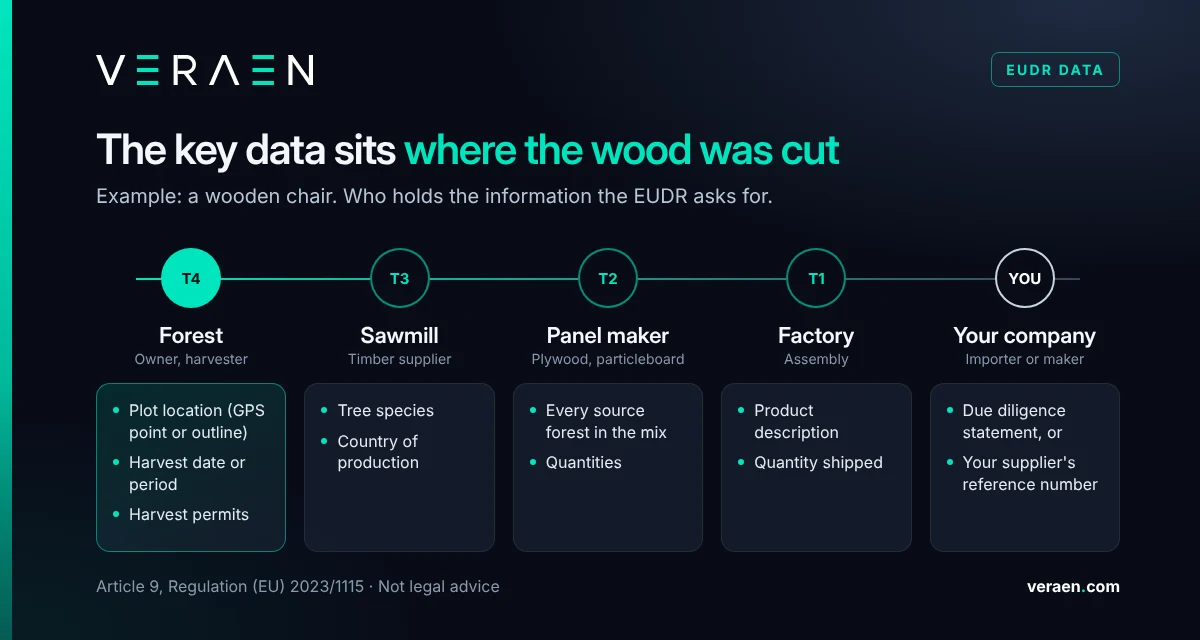
Geolocation is the hardest part. For a plot of up to 4 hectares, one GPS point with six decimal places is enough. For larger plots, you need the outline of the plot as a polygon (cattle excepted). A product mixing wood from many plots, such as particleboard, needs the location of every plot.
Due diligence in three steps
Due diligence is how an operator shows that the risk of a product not complying is negligible. It has three steps, and the result is filed as a due diligence statement.
- Collect the information listed in the previous section, for every product and every plot of land.
- Assess the risk that the product is linked to deforestation or illegal production. Look at the country of production, the complexity of the supply chain, and the risk of mixing with products of unknown origin.
- Reduce the risk until it is negligible, for example by asking suppliers for more documents, independent audits or satellite checks. If the risk stays more than negligible, the product cannot be placed on the market.
The operator then files the statement in the EU information system (TRACES) and receives a reference number. For imports, customs needs this reference number.
Country risk makes a difference. In May 2025, the Commission classified every country as low, standard or high risk (Implementing Regulation (EU) 2025/1093). All EU countries are low risk. Only four countries are high risk: Belarus, Myanmar, North Korea and Russia. For products sourced only from low-risk countries, operators can follow a simplified procedure and skip steps 2 and 3. They still need all the information from step 1, a statement, and a check that no material from other countries is mixed in.
Checks and penalties. National authorities must check at least 1% of operators sourcing from low-risk countries each year, 3% for standard risk and 9% for high risk. Penalties are set by each EU country. The maximum fine must be at least 4% of the company's total annual EU turnover, and authorities can also confiscate products and income.
Checklist: what to do before 30 December 2026
With only weeks left, start with scope and supplier data: they take the longest.
- List your products and their CN codes, and check each one against the current Annex I (updated 18 September 2026).
- Decide your role for each product flow (operator, downstream operator or trader) and check your company size, so you know your deadline.
- Map the supply chain of each covered product back to the plot of land: direct supplier, processor, sawmill or plantation, forest or farm.
- Ask suppliers for the data now: species, country, geolocation, harvest dates, legality documents. Add EUDR data duties to supplier contracts.
- Check the country risk for each country of production, and whether materials from different countries are mixed.
- Write down your procedure for risk assessment and risk reduction, and keep evidence of each check.
- Register in the EU information system (TRACES) and try filing a test statement before the deadline.
- If you are downstream, set up a way to receive and keep your suppliers' statement reference numbers.
- Check your packaging separately. Packaging sold with your product is outside the EUDR, but it falls under the Packaging and Packaging Waste Regulation (PPWR). See our PPWR guide.
- Keep records for five years and review your sourcing when the Commission updates the country risk list.
Frequently asked questions
When does the EUDR apply?
From 30 December 2026 for large and medium companies. Most micro and small companies follow on 30 June 2027, except for timber products already covered by the old EU Timber Regulation, which start on 30 December 2026 for everyone.
Does the EUDR apply to small companies?
Yes. Small companies get more time for most products and lighter duties as downstream operators or traders, but there is no general exemption.
Is all wooden furniture covered?
Most wooden furniture is covered, including wooden seats, tables, beds and kitchen units. Furniture of metal or plastic is not, and used or second-hand furniture is excluded.
Is packaging covered by the EUDR?
Packaging used only to support, protect or carry another product, and sold with it, is outside the EUDR since 18 September 2026. Paper, cartons or pallets sold as products in their own right are covered.
Are leather and cotton covered?
No. Cotton was never covered, and cattle hides and leather were removed from the list on 18 September 2026.
Do I need geolocation if I source from a low-risk country?
Yes. Low-risk sourcing lets you skip the risk assessment and risk reduction steps, but you still need all the information, including geolocation.
I buy from an EU supplier. Do I file a due diligence statement?
Not if your supplier already filed one. As a downstream operator or trader, you keep the supplier's reference number if you are the first company after them, and you register in the EU information system if you are not an SME.
What happens if I don't comply?
Each EU country sets the penalties. Maximum fines must be at least 4% of your total annual EU turnover, and authorities can confiscate products and income and stop you selling the product.
How VERAEN is designed to help
VERAEN is a product compliance platform with expert support, currently in pre-launch. It is designed to:
- Collect supplier data once, from every tier of the supply chain up to Tier 4, including the plot-level data the EUDR asks for.
- Check each product against the rules that apply to it, and reuse the same data for the EUDR, GPSR, PPWR and the Digital Product Passport.
- Give you ongoing support from a compliance specialist, to know which rules apply to your company and when.
Want to know when EU product rules change, and when VERAEN launches? Sign up for our compliance updates.
Follow VERAEN on LinkedIn
A short update on EU product rules, every week.
Have a question about your products?
Not sure whether a product is covered, or what your role is? Send us a message or book a short call, and a product compliance specialist will get back to you.
This guide is general information, not legal advice. It reflects the rules as of 5 November 2026. Check the official sources below for your own situation.
Sources
- Regulation (EU) 2023/1115 (EUDR), EUR-Lex
- Regulation (EU) 2025/2650 amending the EUDR (dates, roles, Article 38(3)), EUR-Lex
- Delegated Regulation (EU) 2026/2102 (updated Annex I, packaging exclusion), EUR-Lex
- Implementing Regulation (EU) 2025/1093 (country risk classification), EUR-Lex
- European Commission: Regulation on deforestation-free products
- EU Access2Markets: Delay until December 2026 and other developments